Value Debt 101
What Value Debt Actually Means
“Value debt” is that felling you get when someone helps you a TON for free so you kinda feel like you owe them a little. Not in a guilty way, but in “damn, that was helpful.” way.
When you consistently show up and help people solve real problems, the same problems you had, they start to trust you. And when you eventually sell something they're actually interested because you've already proven you know your stuff.
Basically help people so much for free that NOT following you feels wrong.
Step 1: Figuring Out What to Provide Value ON
Before you create anything, you need to understand who you're helping. The easiest way to do this is to think about yourself 1-4 years ago.
Think:
What were you struggling with back then? (Getting followers? Finding clients? Losing weight? Building a side hustle?)
What kept you up at night? List like 3-5 real frustrations.
Things like "I had no clue what I was doing," "I was posting but nobody cared," "I felt totally stuck and overwhelmed."
What do you wish someone had just GIVEN you?
A roadmap? A template? A checklist? Etc.
Step 2: Make Your Free Resource Actually Valuable
This is the thing people will go into "value debt" over so it can’t be bad.
So start by opening Notion and vomiting everything you know about ONE specific thing. The sentences can be unintelligible at this stage.
Now take that mess and get ChatGPT or Claude to organize it into something a beginner could easily follow.
But after you get the Ai to format it, go back through and make it sound like YOU again. Nobody wants to read robot slop.
Make sure to keep the language simple. (fifth-grade level)
Hosting in Notion
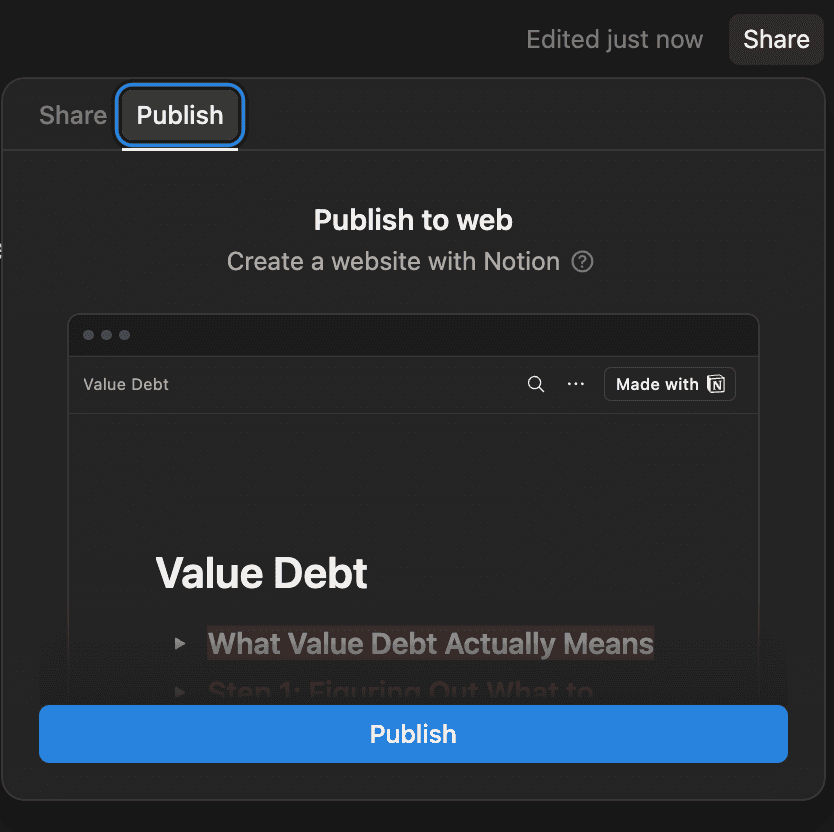
The reason we want to have our resource in Notion is because 1. we can make it look nice and 2. we can publish it online to see and share that link in our automation.
To host your free resource in Notion:
Top right “Share” button
Press “Publish”
Copy link and put into your ManyChat automation
Step 3: Turn It Into a Short Video
Take all the value in the free resource and make a video for it. Think of this like the trailer to the value you want to provide.
The Hook
Your first 3 seconds need to:
Call out a real problem your younger self had
Promise something specific
Example: "I wasted 10 years making content that got zero views. Here's the system I used to grow 24K followers in 4 months”
The hook is basically saying, “I solved your exact problem, and I’m going to show you how you can do it too.”
The Pain Backstory
This is where you prove you've been where they are.
Keep it real and specific:
"For almost a decade, I was posting random stuff online. No views. No followers. I was burnt out, confused, and honestly had no idea what I was doing. I wanted this to be my actual job, but it felt impossible."
When people hear this, they should think: "Holy shit, that's literally me right now."
The Breaking Point
Give them a specific moment that everything changed.
Make it feel like something they could act on TODAY.
"After I graduated, I realized I didn't have another 10 years to waste. So I built one system around this idea of 'value debt' – and that's when things finally clicked."
The Value (What/How/Why)
This is where you actually teach something using my what, how, and why framework.
First describe what the value is.
Then how it works. (steps or otherwise)
Then why the viewer DESPERATELY needs it.
Don't Wait Till The End!)
Drop your call-to-action at like the 2/3 mark of the video.
We don’t wait until the end because most viewers won’t get there.
Make it super clear: comment X to get Y.
Then finish the video with the rest of your value.
Step 4: Set Up The Automation (ManyChat)
Here’s what the automation looks like and a template to plug and play it.
Your welcome: DOWNLOAD
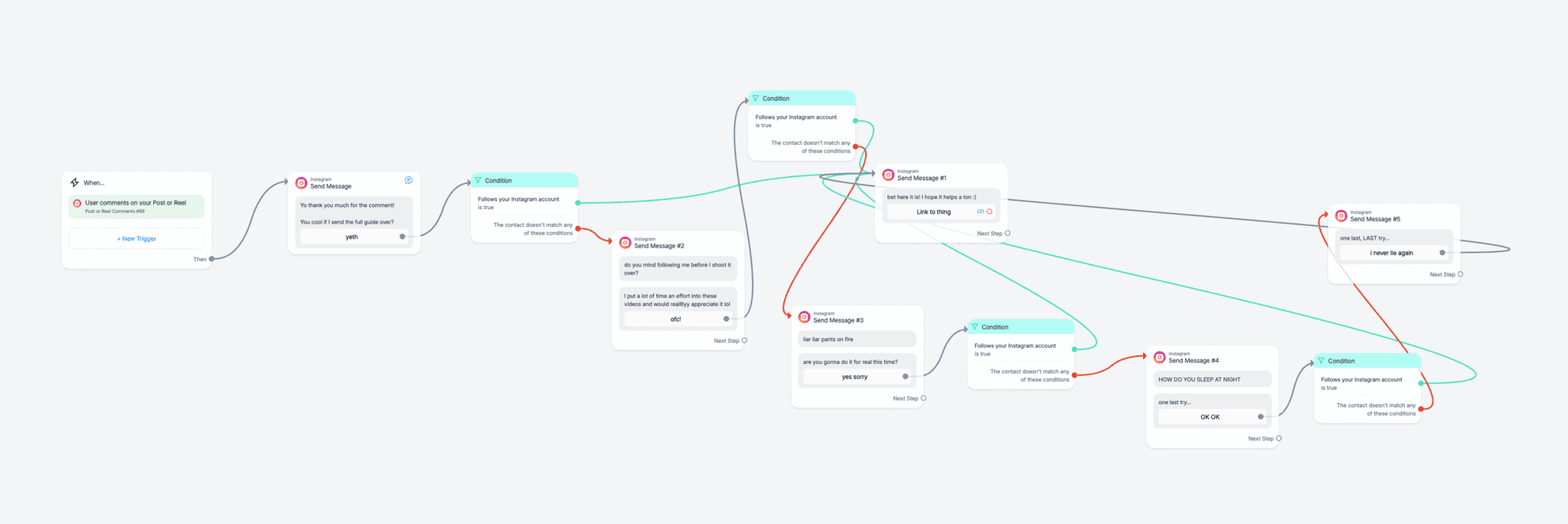
What it does:
Asks for permission to send the resource
Checks for a follow
If they follow already it send’s it to them hassle free
Asks for a follow in exchange for the value
If they follow they get the resource
If they lie the get looped 3 times through the same request
Step 5: Keep Stacking Value Over Time
Every new video + resource = more comments, more automation, more people discovering your stuff.
To really compound this keep all your free resources in the same Notion hub. Meaning when someone gets one guide, they see all the others.
It’s really helpful to have everything in the future as well to use as lead magnets / the start of a course.
And make sure everything you create actually works for real beginners and is based on your real experience.
Treat every free resource like a mini product.
Because if your free stuff is really solid, people will think: "If THIS is free, the paid stuff must be incredible."