Your wants aren't yours
The algorithm has conditioned you to only want what you see other people desiring.
We acknowledge and understand that concept just to scroll for another hour and want exactly what we just saw.
As someone who helps perpetuate this cycle by building brands for people on said platforms full time, I find it important to actually understand the mechanics of this phenomenon.
Not to exploit it, but to grasp what’s actually happening.
(And also exploit it a bit probably too as well)
So in my research this week I fell down a big fat YouTube rabbit hole and discovered connections between desire, perception, and the quantum (?) that fundamentally changed how I perceive desire online.
It started with a video on how the algorithm is feeding us all the same life.
Which of course, like most people, is a concept I’m already cognizant of from my own daily consumption, but I’ve never seen the reasoning articulated and backed this clearly.
This feeding of desire plays directly into the concept called memetic desire.
The idea, built on René Girard’s theory, is simple: we don’t just want things on our own. we want what we see others wanting.
This desire is triangulated: there’s you, the object, and the model (the person whose desire you’re mirroring). If that model is a staged influencer or a bot-amplified trend, it doesn’t matter, you still want it:
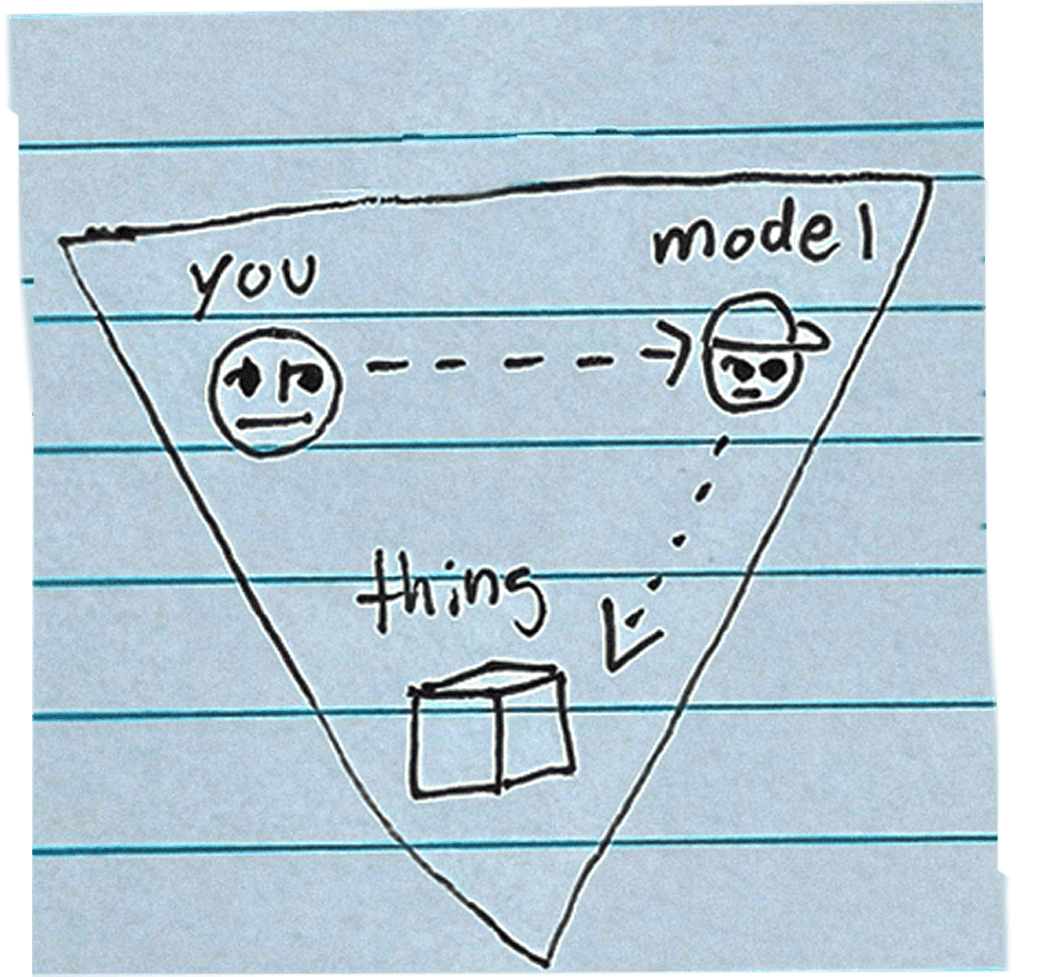
And marketing companies have been abusing memetic desire to hack our brains and perception, using bots to skew what gets shown to us. Meaning that niche algorithm you built “brick by brick” is, in fact, not yours!!
so we’re all essentially wanting the same things, for the same manufactured reasons, convinced we’re being individual about it.
Naturally, this realization bummed me out and my next thought was, “How can I fight this?” (in the pursuit of being indie and niche, of course.)
And the answer isn’t just “removing social media from your life,” that’s unrealistic and impractical for anyone in my line of work.
The answer lies in the creation of internal mediators.
These are strong internal values act as vertical anchors, something that transcends the horizontal pull of mimicry.
For example, if love was your mediator, the question to ask yourself throughout consumption become:
Does this add to my understanding of love?
Does it help me give or receive it more fully?
Does it make me better at showing it?
If the answer to these questions are no, it now becomes something you don’t desire, and that you now, consciously, have a reason to ignore.
Because when we don’t have that internal anchor, the inverse happens.
When bad things hit, we default to comparison, looking outward, measuring ourselves against curated lives, letting our sense of self be built by external forces.
and comparison is the thief of joy blah blah blah etc
After the first video, I realized that this form of comparison is based on our perspective of others. And as stated previously, what we perceive to be going on social media has been curated to make us feel less than so that we want to buy things to fill that gap.
The argument in this video is that the best thing you can do in your adult life is to learn how to think. Ultimately summing up that the reason for concept of a college existing is to help young adults learn how to think choose what they’re paying attention to.
Because we alone have the capacity to decide how we perceive our reality, our thoughts control everything.
The guy who cuts you off in traffic could just be an asshole or he might have his wife in labor in the back seat, you literally can never know. But you can act like you do, and with that lens the world seems less harsh and in turn, so are you.
Meaning HOW we think is the variable, everything else flows from it.
This led me to a video on that exact concept, which label it “as above, so below” or said differently, “as within, so without.” How we feel internally is mirrored in how we experience the world.
We, as humans, are the problem. Us, in the way we’re conditioned societally are trained to react, defend, explain, and fight. In that order. Because we believe things happen to us, and that belief is inherently self-centered.
Then, because of the repeated external reinforcement of that conditioning, the connection to who we actually want to be is rusted over. (However, that connection is still there and always will be, it just needs to be renewed)

So when you discover and apply this truth, every disturbance becomes a test in the journey to renew that connection and become who you already are.
The practice is noticing and then acting as if it doesn’t bother you. Not because you’re “suppressing your emotions” but because it genuinely shouldn’t.
How would you move through the world if you were always grounded in who you are?
Not in a narcissistic way, but in the way a person who deeply values others as much as themselves, listens well, and lifts the people around them would act.
That’s the version of “ego” that doesn’t need a death.
This last video brought everything full circle, which felt very cool to my 2:00am self.
Synchronicity, is Jung’s concept that meaningful coincidences exist outside of cause and effect. Like when events that have no logical causal link feel undeniably connected. Not random or based in superstition, just patterns that appear when you’re paying the right kind of attention.
(the kind of attention that your “higher self” would pay)
The idea reinforces something the other three videos kept circling: we are both the good and the evil.
The thing we want and the thing that wants it.
When you start to quiet the noise, that manufactured desire, the reactive conditioning, the reflexive comparison all of those patterns become impossible to ignore. The right things show up and the connections reveal themselves.
So notice what keeps appearing when you break the patterns that are keeping you from that version of yourself. We you internal mediate and watch the world become a wonderful reflection.
The life you actually want will never be something the algorithm can sell you.
same time next week?