Ideation
This is where most videos fail. Yes, at step 1.
Because again, you need to be honest with yourself: all your ideas aren’t good ones.
In my content career I probably have a ratio of about 10:1 when it comes to ideas : video’s produced.
Meaning, if were going to spend anywhere from 5 hours to multiple weeks making one video, long or short, why would we want the base idea to suck?
We’d be shooting ourselves in the foot. Ouch!
But.. (and there’s always a but)
We also don’t have time to spend hours and hours thinking about what to create everyday.
Which is unfortunately why 99% of people who want to make videos never start.
They’re not confident in their ideas, and therefore are not confident in their content.
So here’s how I come up with ideas that are:
Good and based in proof
Unique enough to grab attention, regurgitation is gross.
1. COMPETITOR BASED IDEATION
This is how you’ll come up with the majority of the videos that will be made for growth. And the process is quite simple.
Once you run through all the steps linked above you should have a good idea of the foundation your need to build upon in order to make a solid video.
The goal of competitor based ideation is to spend your time making videos that are rooted in proven concepts.
What I typically do is:
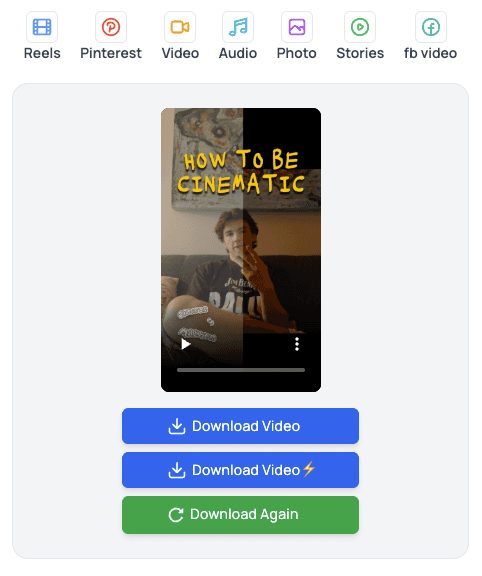
Copy the link of one of my analyzed videos into THIS INSTAGRAM REEL DOWNLOADER.
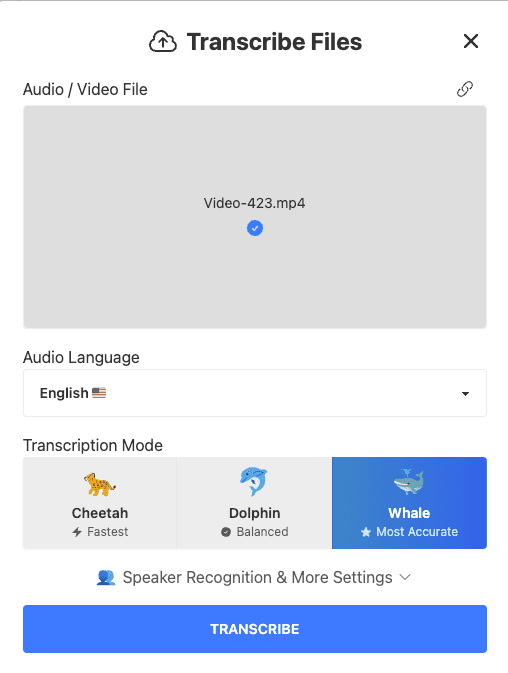
I then upload that video into TURBOSCRIBE (3 free videos/day) and deep dive into analyzing the script. (use the “Whale” setting for the most accurate AI transcription.)
Then I look at the keywords used and pull parts that I think were done well. (typically the hook as if it worked once, it’ll work again.)

I then re-write the script in my style using new value that I research for and my own story/experience. The goal here is to make the video better than the one you downloaded.
2. BORED IDEATION
This one is going to be hard for you if you doom-scroll.
Firstly, stop doomscrolling, you have stuff to do. No you are not “researching videos.”
It is my belief that in order to have true semi-orignal thought we need to consume NOTHING. No content, no music, no movies, nothing.
The world we live in is plagued by people CONSTANTLY trying to steal your attention at every waking moment. So what happens if you don’t let them, and just be in the moment?
Creativity. You creative core has time to be thought on.
I know this sounds hippie but bear with me.
I to the gym without headphones, to torture myself into thinking.
These are where my most creative, scroll stopping ideas come from.
So sit down and try and do nothing but think for the next 45 minutes. It may feel silly but odds are you’re going to have some pretty solid ideas pop up.
Rick Rubin explained it in his book “The Creative Act: A Way of Being:"
Ideas come to us, not because they’re ours because it time for them.
We need to be a vessel for ideas.
The best way to do that just happens to come from being bored.
(Do you think Thomas Edison invented light bulbs by scrolling TikTok?)
And when I’m being bored my ideas typically stem from:
Pain point I’m thinking about:
“Ugh I do NOT want to edit today.”
Which turns into something like:
“How can I spend the least possible time editing today?”
I then consider the story and value:
“Would other people benefit from faster editing times (yes.) Could I make the story of me figuring that out be entertaining? (also yes.)”
What keywords, pain points, and dream results would make this massively relatable?
Keep in mind keywords can also be emotions like “overwhelmed” or “burnt out.”
3. UN-BORED IDEATION
Now I know I just talked about monk-levels of focus. But I also have a deep love for movies.
So in between reaching Nirvana and Netflix, you also need to INTENTIONALLY consume good stuff, in all of its forms.
We get ideas by encountering issues in our environment and using our knowledge to face them, so we have to cater our base of knowledge to the things we want to make.
On top of movies, I read books, and watch content related to or in the style of the stuff I want to make.
The inverse holds true as well.
I make it a point to watch media different to my interests, contrast is a great retrospective.
It’s really easy to get inspired when you transforming ideas from different fields into things applicable in your own field.
You stack and remix knowledge to make new ideas.
Shakespeare used to recycle ideas from old plays and explore them in new ways, making them into the classic tales we know today.
You can also take scientific knowledge as an example, new inventions are built on top of all the work of those who came before us.
So while we all desperately crave unique thought, great creative entrepreneurs aren’t coming up with things from thin air. They’re combining existing truths, stimuli, and frustrations into a new lens that feels fresh, specific, emotional, and immediately useful.
The best ideas are easy to understand, hard to ignore, and impossible to unsee.
4. NICHING DOWN
If your struggling with niche this is a great way to carve out your little corner of the internet and differentiate yourself from the competition.
Ask yourself: “What am I creating for specifically?”
Example:
Filming
Filming Cars
Filming Exotic Cars on the Street
Filming JDM Cars at a Car Meet for Short Form Content
If your not familiar with Daniel Dalen one reason he blew up is because of how niche he was within the online entrepreneur space. Mainly his ability to speak fluent Chinese.
5. CREDIBILITY
This is helpful for your offer and building social proof. If you don’t have the credibility yet — that’s ok, it comes from failing a lot, not giving up, then doing one thing for a long time until you can breath through it.
It’s all about where your speaking for:
An expert would say: “I am…”
Someone who is curating experts says: “According to…”
And someone who is working towards expertise through personal experiences would say: “I have…”
6. THE FOUR PATHS
The four paths are how you find the best way to breakdown an idea for the audience. So say you had an idea for how to do a pushup.
Actionable → “Here’s How…”
Here’s how to do 25 pushups even if you can’t do one.
Analytical → “Here’s the Numbers…”
Here’s why doing 25 pushups a day can make you 157% stronger.
Aspirational → “Yes, you can…”
Yes, you can do a push up even if your overweight.
Anthropological → “Here’s Why”
Here’s why doing push-up make you a better person.
7. ELEVEN APPROACHES
This goes well with bored ideation. After you sit for 45 minutes and write everything that comes to you, you’re probably going to have an abundance of ideas and no way to sort them out.
So we use the eleven approaches to dissect these ideas and truly find which ones are good and worth the effort it takes to curate a video around them.
You want to do the 11 approaches for each idea.
We’ll use the pushup example again:
Approach | Example |
|---|---|
1. How I | How I learned how to do a pushup in 1 day. |
2. Lessons Learned | Lessons learned from doing 100 pushups every morning |
3. Mistakes | Common mistakes beginners do when doing pushups. |
4. Quotes | “Pushups saved my life.” |
5. Ways | 5 different ways to do pushups to hit different parts of the chest. |
6. Tools | Best tools to help you get better at pushups faster. |
7. Trends | I tried the viral 50-push ups challenge. |
8. Statistics | Doing 100 pushups a day will make you 100x stronger in a week. |
9. Reasons | 5 reasons you need to be doing pushups. |
10. Examples | The perfect pushup form. |
11. Moments | Things I think about while doing 100 pushups. |
Now we know how to come up with ideas , but how do we figure out what ideas to actually pursue?
Fun fact again: One of my first content creation videos was about ideation and how to filter the good vs. bad ones.
I created The V.A.S.T Filter to make sure my ideas were worth the time I was spending on them.
But what your doing is asking yourself:
Is it Viral?
Will people share this? Would I share it?
Is it Actionable?
Does it drive behavior or response?
Is it Specific?
Is it tight, focused, and punchy? Does it tackle an issue?
Timeless/Topical
Is it evergreen or riding a trend? Would I like it in 3 months?
And if you’ve done what we’ve talked about before and really taken the time to deconstruct your ideas, the ones you like the most should fit into the filter quite nicely.
One last thing in this mental-masturbating section:
Recognize that premature evaluation kills ideation. If you think all your ideas are bad, they will all be bad.
But, evaluative thinking after idea generation leads to better execution and momentum.
This taps into the psychology of feedback loops, which is crucial for dialing in your creativity over time.
And sometimes it just may not be an ideas time yet, so practice having your journal act as a place to house all the possible ideas until it feels like the right Time.
Sometimes thoughts have to mature before being evaluated.
The simple act of writing down everything is the best way to keep you from forgetting ideas until you can use them.
WEEKLY PRACTICE
Practice this every Sunday:
Input Roundup: Save 10 new ideas from your week of content.
Idea Buildout: Go through the ideation methods for each of your thoughts.
Share: Pick 2-5 to post, pitch, or test throughout the week